The Annual National Medico-Legal Seminar (ANMLS), held from 13 to 14 September 2025, brought together an illustrious faculty to address a cornerstone of professional practice: Medical Record Keeping in an Evolving Technological and Regulatory Landscape. Jointly organised by the SMA Centre for Medical Ethics and Professionalism and the Medico-Legal Society of Singapore, the seminar provided a timely forum to discuss the intersection of clinical care, law and emerging technology.
The clinical foundation: what defines a good record?
Clin A/Prof Gerald Chua opened the proceedings by defining the dual nature of medical records as both a vehicle for clinical communication and a legal document of record. He emphasised that good records must be clear, objective and contemporaneous. A critical challenge highlighted was the "copy and paste" culture prevalent in handling electronic medical records (EMRs). He reminded audience that documenting medical records should focus on content, context, complexity, concision, checking (or accuracy), and the conversation and consent with the patients.
Judicial perspective: records in the courtroom
Ms Kuah Boon Theng provided a sobering look at how the judiciary perceives medical documentation. She discussed the impact of Section 37 of the Civil Law Act, which shifts the focus of informed consent toward what a "reasonable patient" would want to know. In the eyes of the court, the absence of a record often suggests that an event did not occur. She highlighted the case of Ang Yong Guan v SMC, where the court emphasised that while doctors have clinical latitude, any departure from standard guidelines must be supported by objective justification clearly documented in the notes.
Digital shift
Prof Teo Eng Kiong addressed the rising complexities of record keeping in the age of EMRs. He highlighted that the unique challenges of the burden of high information volume and the liability of inaccurate data should be addressed by the sensible use of good clinical practice and legal reasonableness. Furthermore, he touched on the challenges of evolving technology regarding EMRs and noted that it is necessary to establish the clarity of various stakeholders' roles and responsibilities.
The NEHR framework: access, use and ethics
A major highlight was the discussion on the National Electronic Health Record (NEHR) and the then upcoming Health Information Bill (HIB). Dr Peter Chow discussed the guidelines for contributing to and accessing patient information. Ms Rebecca Chew elaborated on the ethical principles and professional standards required when using patient data within the NEHR framework. Key takeaway points included:
- Access is strictly for the "purpose of patient care".
- Clinicians should only access information relevant to the current clinical context.
- Using NEHR data for employment screening or insurance assessments is strictly forbidden and carries heavy penalties under the HIB.
While patients can opt-out of sharing their records, the HIB ensures that critical data is still contributed to the national system for emergencies.
The day ended with a high-level panel discussing the potentials and challenges of NEHR, featuring members of the Ministry of Health (MOH) Workgroup for the Guideline for Appropriate Access and Use of NEHR and representatives from MOH and the Health Sciences Authority, including A/Prof Thomas Lew, Dr Sumytra Menon, Dr Goh Min Liong and Adj Prof Raymond Chua.
The AI frontier: redefining documentation
The seminar's second day focused on the "black box" of artificial intelligence (AI) technology, exploring how it will affect the creation and use of medical records.
Promises and pitfalls of AI
Prof Joseph Sung discussed the transformative potential of AI in alleviating "documentation burnout". AI systems can assist by automating routine tasks, yet Prof Sung warned of significant pitfalls, including the risk of algorithmic bias and the loss of the human touch in clinical narratives. He questioned whether AI would make the process more effective or simply more "problematic and clumsy". The shift from pen-and-paper to AI-assisted records represents a major milestone that requires a balance between technological efficiency and clinical accuracy.
Ethical frameworks for AI
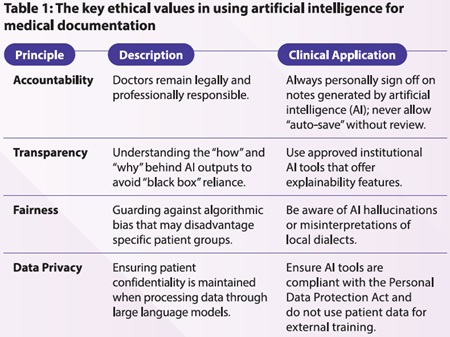
A/Prof Liu Nan introduced an ethical framework specifically for using AI in medical record keeping. He emphasised that AI should not be viewed as a replacement for clinical judgement but as a supportive tool. Key ethical considerations, summarised in Table 1, include:
- Transparency and explainability: Clinicians must understand how an AI arrived at a summary or recommendation to avoid "black box" reliance.
- Data privacy: The use of large language models (LLMs) raises concerns about patient data being used to train external models without explicit consent
- Accountability: A/Prof Liu suggested that the final responsibility for the accuracy of an AI-generated note rests with the signing clinician.
Practical implementation and strategies
Prof Ngiam Kee Yuen provided practical tips for healthcare professionals navigating this transition. He illustrated the use of LLMs and chatbots that listen to the doctor-patient conversation and draft clinical notes in real-time. This allows clinicians to focus on the patient rather than the screen. However, Prof Ngiam cautioned on the following points:
- Verification is mandatory: AI can "hallucinate" or misinterpret clinical nuances; therefore, every AI-drafted note must be meticulously reviewed.
- Bias awareness: AI models trained on specific populations may not translate accurately to Singapore's diverse demographic, necessitating local validation.
- Continuous learning: As AI evolves from a "clumsy" tool to an efficient partner, clinicians must stay updated on the latest guidance to face these challenges confidently.
Lessons from legal defence and cybersecurity
Speakers from our two sponsors, Medical Protection Society (MPS) and CyberSafe, also contributed great insights regarding medical records. Dr Robert Hendry of MPS used real-world cases to demonstrate how medical records serve as a strong defence. He reminded the audience that records can assist with good practice and accurate record of the consent process is important if one is subsequently questioned. The doctors should also be aware of other sources of records: nursing records and videos.
As records are increasingly stored in the cloud, cybersecurity has become a clinical necessity. Mr Dave Gurbani of CyberSafe highlighted that many cyber attacks target small and medium enterprises, including private clinics. Referring to MOH circular No. 13/2025, he reassured fellow doctors that to mitigate cybersecurity legal liability, the healthcare centre/institution is required to exercise due diligence in choosing a white-listed clinic management system or EMR system and to ensure their clinic processes and staff are able to meet the Cyber and Data Security requirements.
Conclusion
ANMLS 2025 concluded with a clear message: while the tools of our trade have changed from pens to pixels, the underlying professional duty remains the same. Proper record keeping is not simply an administrative burden but an act of patient safety and professionalism. As we transition into a mandatory NEHR environment under the HIB, the principles of clinical relevance, transparency and data security will be the pillars that sustain the trust between the medical profession and the public. Clinicians should not be "scared" of these developments. By adhering to fundamental principles and up-to-date guidance, we can harness technology to improve both our practice and patient outcomes.