I would like to thank the SMA President, its Council members and all who are here tonight. You honour me with this award and your presence.
We could have dispensed with formalities. Good zi char and beer at a local coffeeshop would have suited me just fine – even preferred. But having worked in defence establishments for many years, I know that traditions build esprit de corps and so I am happy to join all of you at this SMA Annual Dinner.
I want to thank A/Prof Prema Raj for his kind words. I am proud of what A/Prof Prema Raj has accomplished to advance transplant surgery in Singapore. Our generation might live to see the day that organ transplants are as common as artificial joint replacements. In time to come, what he and other pioneers have begun in Singapore will reap bountiful harvests.
A life in politics and medicine
The SMA has honoured me, but I am not quite sure what I did for the medical community to deserve this award. Lest you think this is false modesty, I shall reveal a snippet of my political life tonight not commonly known. When I was approached to enter political office in 2001, I had a specific request of the Prime Minister then – that I would not be sent to the Ministry of Health (MOH). It was a request, not a condition. But thankfully, then and subsequent PMs that I have served acceded to my wish, so I was never deployed to MOH in all 24 years of my political office. You are probably wondering why I avoided MOH.
The simple reason is that I have too many friends in healthcare, particularly doctors. I even married one – who led Singapore Health Services for more than a decade! And I know that running a healthcare system, in the context of governing Singapore to ensure both affordability and a sustainable health budget, means difficult decisions. Patients' needs are paramount and to meet those needs, healthcare workers are in my mind among the most dedicated, altruistic and hardworking of professionals. Despite this, healthcare systems globally are always challenged with inadequate resources – manpower particularly.
And so I thought, better for me to stay out of MOH to serve other Ministries instead and leave MOH to more intrepid souls. Some of you might conclude that I chose the easier path. Perhaps, but as my unionist friends would say in Hokkien – jit lang jit pua, kan cheng buay sua. Loosely translated for tonight – to keep relations cordial, you keep to your half and I will keep to mine. That strategy seems to have worked. Despite keeping away from healthcare, SMA has decided to bestow on me tonight's award. I take it then that you prefer benign neglect to meddlesome midwifery from doctors-turned-politicians.
I spent about half of my adult life in medicine – most of that in Singapore General Hospital, and only about four years in private practice – and the other half in politics, about 20-plus years for each. Which I suppose puts me in a respectable position to compare the two – medicine versus politics, the doctor versus the politician. So for tonight's speech, let me share a few reflections on these two different arenas.
Reflections on healing society
The doctor deals with the patient in front of you with his/her family – that sacrosanct relationship defines and scopes the doctor's responsibility and accountability. This is hardly the case for the politician who gets to see the underbelly of society. For the political servant-leader and his/her constituent, the terms of engagement are anything but simple or scoped. I once had a mother and adolescent son at my Meet-the-People Session. I can still picture them – both had numerous tattoos and the mother looked deeply troubled. They needed financial help, which we gave to alleviate some day-to-day needs. The mother then confided that her main worry was that this son would end up in jail. You see, her husband and three older children were already in jail. She too had been just released from prison, and she wanted in earnest to avoid that plight for this remaining son. As doctors, we are taught to tackle the root causes of ills, but how do you deal with social challenges for this family?
What are the fundamentals which can alleviate social ills and elevate society, for those who aspire to be a doctor to heal the nation or our world? After 24 years in political office, my conclusion may surprise you because it sounds somewhat simplistic – here it is anyway. Good medicine to build healthy nations requires basic but pure elements. And the most important element?
Trust. Trust is intangible but so very substantive. It is ephemeral but its effects, both good and damaging when trust is lost can last a lifetime. The late George Schultz, a US Secretary of State who served two US presidents and was a long-time friend of Mr Lee Kuan Yew, penned an essay when he turned 100 in 2020.1 He wrote, "Trust is the coin of the realm. When trust was in the room, whatever room, the office room, the government room, or the military room – good things happened. When trust was not in the room, good things did not happen. Everything else is details." The distilled essence and wisdom from a statesman who lived to tell it all at 100 years is worth listening to. But honestly – is trust that important in real life? Surely, there are more powerful forces at play?
In the aftermath of the COVID-19 pandemic, a paper was published in the Lancet in 2022.2 The purpose of that study was straightforward. The investigators wanted to establish from this truly global event the main factors that impacted infections and deaths. They input data from 177 countries globally – reliable datasets, not just reported but comparing excess deaths, so that unreported ones could not be hidden. Multivariate analysis and regressions were performed on a range of parameters that influenced the outcome. The findings were illuminating. As expected, factors such as age structure of societies, mean population body mass index, geography (living below 100 m) and gross domestic product per capita affected infection and death rates. But across systems that varied widely in socioeconomic systems, cultures, forms of government, healthcare systems and capacity, what came out as a "persistent and substantive" influence? Yes, trust. The higher the trust in government and among people, the better the outcome. You would think that countries with greater healthcare capacity or pandemic preparedness would have performed better – they did not. If trust was lacking, the results were poor. Trust, an intangible quality led to fewer real infections. The papers' authors did an extrapolation – if all countries improved trust in government to the level of approximately the 75th percentile of measured countries, there would have been 12.9% fewer global infections. Similarly, if all countries improved interpersonal trust to the 75th percentile of measured countries, the effect would be even larger, 40.3% fewer global infections would have occurred. Astonishing real-world findings about the power of trust!
Erosion and rebuilding of trust
Trust takes years to form and seconds to break. Each day in your clinics or hospitals where you faithfully tend to each patient, keeping high standards, doing research to better outcomes; you build up a reservoir of trust that lasts – it explains why some of you remain as primary physicians to more than one generation within families.
How does believing and building trust in our relations with others – whether family, friends, patients or clients, fellow workers or neighbours – sit in a world that is increasingly going the other way? In the last two decades, trust has been eroded enormously. The global financial crisis of 2008 transferred private to public debt, but few were deemed accountable for the fallout. The COVID-19 pandemic pushed many countries deeper into debt and lives were unnecessarily lost, because people did not trust what they were told, even by their leaders. The wealth gap between rich and poor is widening globally, across and within countries. I have heard ministers from the Pacific Islands openly declare at public fora that they have given up hoping that the developed world will help them. They have lost faith and trust, yes that word again, as communities vanish when islands become submerged. The Global South is similarly despondent with the lack of aid. In this decade, trust between communities and even among allies has broken.
Instead, the currency of the day seems to be power and leverage for self-advancement, never mind if the global commons for the good of all are damaged as a consequence. "The strong do what they can, and the weak suffer what they must," a maxim born out of a power-based and cruel antiquity has reasserted itself in our day and age. In this kind of world, can trust gain any traction? It seems almost naive to believe in principles, let alone rules to govern relations between countries. Building trust in today's milieu seems outdated and irrelevant.
I would argue quietly the reverse. Because trust is in short supply, those who can engender trust command a premium. This is true, whether it is building trust within your family, your friends and colleagues, your communities, the society and world we live in. Do not misunderstand – me building trust when others are grabbing power and possessions is not cost-free. Indeed, it will be costly. Secretary Schultz said that when trust is not in the room, good things do not happen. I agree with him. We must expect that the next decade or two, hopefully not longer, will become more troubled and difficult for all countries.
We are in a historical cycle where geopolitics has swung the way of increasing rivalry dominated by self-interest. As in the past, each generation must find out for themselves at a painful cost that this approach is self-defeating in the longer run. Hopefully then, our world will revert to one built on trust and mutual benefits. Our biggest investment therefore amid all the ongoing disruption and disintegration is to build trust now, among ourselves within Singapore and with other trusted partners outside.
I wish the SMA and all of you fulfilling lives that enrich your families and the communities you live in. Thank you again for this SMA Honorary Membership.
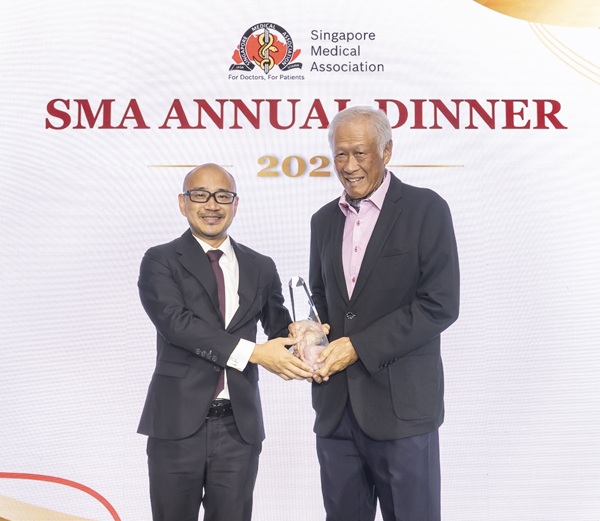
Dr Ng Eng Hen receiving the Honorary Membership from Dr Daniel Lee
