Our colleagues have many passions and pursuits beyond their medical practice. In this Feature, SMA News invites Dr Ellie Choi and Dr Bertha Woon to share about their experiences in the performing arts, how they developed a passion for their musical craft and how it has enriched their lives.
Ellie Choi
What does it take to become musical? I was invited to write about being a harpist, but since the harp ranks low on practical concerns, I have instead highlighted tips for picking up an instrument. Whether it is for yourself or your child, I hope you will find this helpful.
Consider noise pollution
In the early stages, "practice" sounds nothing like music and more like misplaced ambition with volume. As the adage goes, choose your suffering wisely. Some instruments are more beginner friendly, including fixed pitch instruments like the guitar or piano that you simply pluck or press to release a note. In contrast, most string and wind instruments require precise finger placement, mouth position and breath control before a stable note emerges.
Volume is also another consideration – higher-frequency instruments like the violin and flute are particularly screechy and brutal compared to deeper and more resonant instruments such as the cello and saxophone. Drums and brass instruments also tend to rumble through an entire apartment.
Transferable music skills
The upside of suffering through a variable pitch instrument is that it trains the ear and forces the player to calibrate as he/she plays, leading to early pitch discernment.
Music reading-wise, the piano, organ, harp and harpsichord are the only instruments reading both the treble and bass clefs simultaneously, building theory and a broader understanding of harmony and structure that transfers well into learning a second instrument. Other instruments tend to read only the treble or bass clef, and the viola is the sole user of the alto clef.
Solo value and public appeal
Many parents – much to their children's chagrin – would like a resident home performer. If you have just one child to press into service, instruments covering both melody and accompaniment like the piano and Chinese instruments like the guzheng and yangqin are best. If you are lucky (or to some, unlucky) enough to have more children, or willing company to play with, then the world opens up. A looping pedal can also allow instruments like the violin and cello to layer phrases in real time, forming your own ensemble.
For public engagements, an unusual instrument like the harp can compensate for mediocre skill. Vocals, keyboard and guitar are popular preferences, but they also dominate mainstream music, and the average listener will be more discerning.
Orchestras
There is a particular joy to playing in an orchestra. 50 individuals sharing the stage, no longer producing individual sounds but a single rich body of music that envelops you in true surround sound and stirs you from deep within. That said, orchestral practice was when I wished I had picked a more common instrument like the violin. Many pieces have no harp parts and I spent much of our rehearsals not playing. Even pieces that featured the harp were punctuated by long stretches of rest where I would count 60 bars of silence.
Other practical considerations
Instruments are financial, spatial and logistical commitments. Apart from the cost of the instrument, space and portability should be considered too. A piano needs sizable space in a home while a flute needs only a drawer. Instruments with mouthpieces may potentially affect dental or jaw development. Wind instruments build lung capacity, but be careful of the self-inflicted Valsalva manoeuvre and raised intrathoracic pressure.
My musical journey
Now, did I consider any of this? Of course not. As a 16-year-old, I simply did not want to walk to the MRT alone after school, so I followed a friend to the harp ensemble co-curricular activity open house during orientation week. Peer pressure did the rest.
Having learnt the piano prior made learning the harp faster, and friends made it enjoyable. This was vastly different from the tearful, dreaded piano lessons of childhood. You do not need to love music to start playing it. I certainly did not – and still have no strong love for music in the abstract.
Perhaps that is the real gift of learning music. Not talent, nor taste, nor some grand love. But the chance to grow into something through the simple act of returning to it regularly. The learning came first. The appreciation came later. And somewhere along the way, what began as peer pressure became something worth keeping.
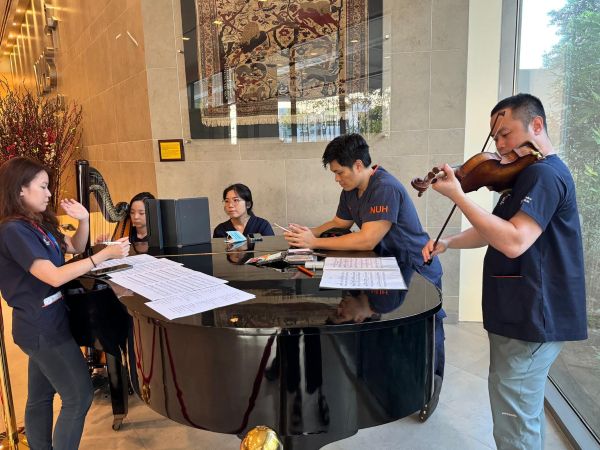
Meditunes is a music group made up of healthcare professionals (non-cluster specific) who perform for hospital, charity and community events
Bertha Woon
I started learning music (piano and the Electone) around three years old. At nine years old, my piano teacher's professor felt that I was gifted and wrote me a recommendation to study music at the University of Edinburgh. My parents declined because they thought I needed to at least have my PSLE. However, they took his advice to nurture a gifted student seriously and supported me to study five instruments (piano, Electone, pipe organ, oboe, cor anglais), composition and arrangement. I had a total of 12 excellent music teachers.
As a musician, I peaked at 18, playing first oboe in the Singapore Youth Orchestra (SYO). Just as my teacher applied to the Munich Conservatory for me, I was informed that I got a place at NUS Medicine. My oboe teacher, Lei Rong, advised me that I could be a doctor who played the oboe and people would clap for me to give me face because I am a doctor. However, the reverse would not happen. His classic line "傻孩子!如果有其他路可走,就别走音乐这条路" ("Silly child! If you have another path to take, do not choose music.") echoes in my memory to this day, especially when wind musicians were unable to perform much during the COVID-19 pandemic.
Music or medicine?
In medical school, for the first six months, I kept dreaming that I was at orchestra rehearsals and woke up during tacet.a I questioned if I had made a wrong choice. I had difficulty playing my oboe for years during medical school due to the irregular class schedule and issue of finding other musicians to play with. My reeds (organic mouthpieces) wore out often and needed regular replacement. Furthermore, one can only play oboe on an empty stomach and after brushing and flossing our teeth.
Meanwhile, I played piano and organ for church services and as a church choir accompanist. Altogether, I played for various churches from age nine to just before the COVID-19 pandemic. Part of my reason for stopping piano was a wrist injury sustained after retracting a 1 kg breast during a skin-sparing mastectomy. My physiotherapist, who happens to be a clarinettist, told me to choose between my career and my hobby. Musculoskeletal injuries of the upper limb are common amongst musicians and can be career-crippling. Thankfully, I have recovered and can continue in my career as a surgeon.
Blending work and play
My oboe playing resumed when I started private practice 21 years ago. I had time to visit the Loree Paris oboe workshop to overhaul my instrument and fix the springs, warped cork joints and leaky key pads. I co-founded the Singing Doctors Society based at Gleneagles Hospital. We performed charity concerts at the Istana for the late President SR Nathan and at the Esplanade for the late Mrs Lee Kuan Yew. This Society was dissolved last year.
For SG50 in 2015, my conductor, cultural medallion winner Ms Vivien Goh, and my fellow SYO alumni got together to rehearse for the SG50 concert at Victoria Concert Hall. This concert (featuring Tchaikovsky's Symphony No. 5 and songs by Liang Wenfu) triggered another wave of practising and performing. Some videos of this concert can be viewed at the following links:
- https://youtu.be/xERbTpvyVl8
- https://youtu.be/EIRLDtCWPjE
-
https://youtu.be/9B7AwfeUZvU
After that, I continued to play oboe with SYO and the Singapore National Youth Orchestra alumni at their rehearsal studio on Bencoolen Street and at the Esplanade. I also play oboe for Gleneagles Hospital now and then – I composed and performed the Gleneagles Hospital 65th anniversary song, and also performed for Mount Alvernia Hospital's Nurses' Day two years ago. For Prof Low Cheng Hock's 80th birthday, Dr Denis Cheong and I composed and performed his birthday song. Sometimes I jam with friends at the piano at the Singapore Botanic Gardens pavilion near Gleneagles Hospital as well.
My latest performance was on 13 June 2026 with D'Nightingales and Friends at Gleneagles' 67th anniversary. I played the instrumental for "You Raise Me Up" and sang Teresa Teng's "The Moon Represents My Heart".
At work, for operations under local anaesthetic, the top playlists my patients request for are by JJ Lin, Stefanie Sun, Jay Chou, Jacky Cheung, Taylor Swift and Ed Sheeran. When I do mastectomies under general anaesthesia, I prefer listening to oboe or cello concertos. I use the pieces as time markers. For example, by the end of the first movement, I should have completed the sentinel node dissection, and by the second movement, the flaps should all be raised. By the time the concerto is over, I ought to have completed the mastectomy.
Over the last few decades, I have evolved from being a perfectionist musician to a more laid-back one who plays for fun with friends. I have to accept that without regular practice, I will never be at my original performance level.
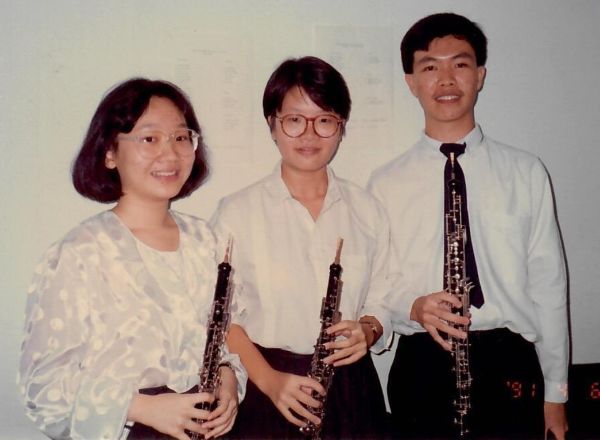
From left: Bertha Woon, Fong Chong Suan, Chen Zhijian in the Singapore Youth Orchestra, 1991
Note
- Tacet (pronounced /ˈtæsɪt/ or /ˈteɪsɪt/) is a Latin musical term that translates to English as “(it) is silent”. It is primarily used in sheet music as a performance direction instructing a particular instrument or vocal part to remain silent for an entire movement or a substantial section of a piece.
Further reading
- Wong SM, Goh V. Rehearsal for Life: Singapore Youth Orchestra 1980-1990. Singapore: Word Image Books; 2015.
