Medical certificates (MCs) are a familiar but consequential part of clinical practice, extending beyond the doctor-patient relationship into occupational, social and legal domains. Following appropriate clinical assessment, a medical condition may render a person temporarily unfit for work or require restrictions on particular duties. In the workplace context, the MC issued by a practitioner certifies medical unfitness and the expected duration of any necessary, foreseeable absence. Appropriate sick leave supports recovery and may reduce the risks associated with presenteeism, including workplace transmission of infectious disease.1 Issuing an MC is a professional privilege and reflects societal trust in the medical profession. This trust may be challenged when patient expectations conflict with professional judgement. Accordingly, MC issuance should be grounded in clinical assessment, functional capacity and any material risk to third parties. Employer preferences, payment arrangements and non-medical benefits must not determine the decision. The Ministry of Health's (MOH) 2024 findings concerning a telemedicine licensee including ultra-short consultations, repeated MC issuance and questionable documentation warrant professional reflection.2
Under the Employment Act, eligible employees are entitled to paid sick leave when certified unfit for work by a registered medical practitioner or dentist, underscoring practitioners' responsibility to issue MCs based on accurate health evaluations. However, the issuance of MCs is frequently influenced by factors far beyond purely clinical considerations. The same diagnosis or procedure may justify different periods of absence because functional capacity depends on the clinical course, recovery, commuting requirements and the actual demands and risks of the job. The relevant question is therefore not the diagnosis or procedure alone, but whether the patient's symptoms and functional limitations are compatible with the actual demands and risks of the job. Requests for a particular duration of leave may reflect the patient's symptoms, expectations, fear about recovery, workplace circumstances or other non-clinical considerations. Where the requested duration appears inappropriate, the clinician should explore the underlying concern and negotiate a safe plan rather than reflexively accept or reject the request.3
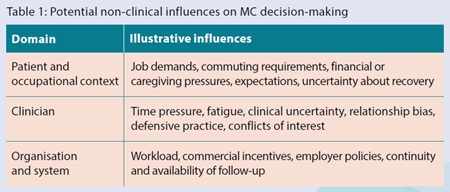
MC issuance must follow an appropriate clinical assessment, including the relevant history, functional and occupational context, and any examination or investigation that is clinically necessary and feasible. Patient preferences should be heard and considered, but certification remains the doctor's independent clinical decision. External pressures may favour either shorter or longer certification, but employer preferences should not determine the clinical decision. Thus, physicians need to manage conflicting interests by upholding the fundamental principle of medical professionalism: the primacy of patient welfare.4 Observations highlighting the myriad factors influencing MC issuance are shown in Table 1. One should note that these illustrative and non-exhaustive factors should prompt reflection but must not substitute for clinical assessment or independently determine MC issuance or duration.
MC issuance standards in telemedicine
With the widespread adoption of technology, telemedicine has improved convenience and timely access to medical care, but it may provide less clinical information than an in-person encounter. The professional standard should not fall because the consultation is virtual; rather, the means of meeting that standard differ. Patient-assisted observations and home measurements may supplement assessment, but findings such as palpation and conventional auscultation may remain unavailable. Where clinically material uncertainty cannot be resolved remotely, the appropriate response is to arrange an in-person assessment rather than lower the threshold for MC issuance. Healthcare organisations should therefore establish clear protocols, train clinicians and ensure identity verification, informed consent, contemporaneous records, secure technology and appropriate follow-up. The National Telemedicine Guidelines 2015 provide foundational guidance, while the Singapore Medical Council (SMC) Ethical Code and Ethical Guidelines (ECEG) require doctors to endeavour to provide the same quality and standard as in-person care.5,6
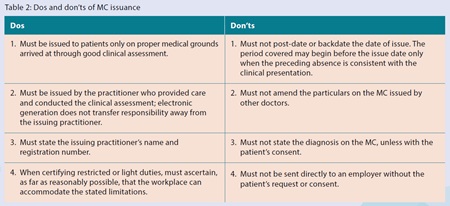
Subsequent regulatory guidance has made these expectations more explicit. MOH Circular No. 30/2024 highlights excessive MC issuance without proper clinical assessment and repeated issuance without appropriate reassessment or follow-up.7 Joint MOH-HSA-SMC Circular No. 87/2024 ordinarily requires real-time two-way video for patients consulting the licensee for the first time, prohibits teleconsultations from being conducted solely through self-service and text-only questions, and places active review obligations on telemedicine licensees.8 These governance expectations were subsequently formalised in the modified licence conditions for remote provision of outpatient medical services, effective from 17 October 2025, including requirements for adequate assessment before MC issuance, escalation of repeated MCs and documented internal review.9 MC issuance is not a standalone transaction but part of the duty of care within the doctor-patient relationship. MC decisions should not be influenced by who initiated or paid for the consultation or by non-medical benefits to the patient. Remote consultation alone should not preclude MC issuance, but its assessment limitations must be considered. Table 2 summarises the dos and don'ts.6,7,8,10
Factors that may compromise appropriate MC issuance
Concerns about inappropriate MC issuance predate telemedicine. Remote delivery may amplify existing risks when assessment, documentation or follow-up is inadequate. Current professional and regulatory guidance therefore emphasises appropriate assessment, escalation and organisational review.6-9 These risks illustrate why telemedicine should be evaluated not only for technical effectiveness but also for its ethical and social implications.11
First, requests for MCs often arise near the end of a consultation, when time pressure, fatigue or high-throughput workflows may encourage premature closure. These pressures do not excuse inadequate assessment, but they are foreseeable clinical governance risks. The clinician should document the medical grounds, functional impact and duration of certification, while the licensee should review patterns such as unusually brief encounters and repeated MC issuance. Second, a request for a particular duration may create interpersonal pressure to acquiesce. Continuity and familiarity can improve contextual understanding but may also introduce relationship bias. Clear explanation, explicit professional boundaries, safety-netting and an accessible route for follow-up can help preserve both the therapeutic relationship and independent clinical judgement.
Patient-reported symptoms are legitimate clinical evidence and should be assessed in context rather than regarded as either automatically sufficient or inherently suspect. The physician should consider their severity, functional impact, associated red flags and whether examination or investigation is required for safe care. Where remote assessment is insufficient, an in-person assessment should be arranged. The SMC ECEG requires doctors providing telemedicine to "endeavour to provide the same quality and standard of care as in-person medical care".6
Conclusion
MC issuance serves employee well-being and workplace safety but remains vulnerable to non-clinical pressures from patients, employers, clinicians and platforms. Telemedicine can improve access, yet its convenience must not convert certification into a transactional endpoint. Responsible practice requires appropriate patient selection, adequate assessment, clear documentation and escalation to in-person care when remote assessment is insufficient. Appropriate MC issuance requires professional judgement that is clinically grounded, occupationally informed and independent of extraneous pressure. The doctor remains accountable for each certificate, while the telemedicine provider must create systems that support safe assessment, follow-up and review. Protecting the integrity of MCs ultimately protects patients, employers and public trust in the profession.