The practice of medicine is evolving rapidly. Beyond clinical expertise, the doctors of tomorrow must also be fluent in technology. Digital literacy has become a new frontier of continuing medical education.
Clinicians capable of harnessing technology can elevate care delivery, manage complex systems and meet evolving healthcare needs with greater efficiency and independence. This shift comes with new baselines: healthcare professionals must be technologically literate and able to work seamlessly in multidisciplinary teams that now include design, engineering and computing specialists.
Yet our training and practice environments often remain behind this curve. Faculties are siloed, leaving little intersection between the problems clinicians face and the technical expertise that could generate solutions. For healthcare trainees, the focus remains firmly on developing clinical acumen, with few pathways for meaningful exposure to innovation and technology.
This critical gap became the starting point for us to build HealthX – a platform ecosystem designed to bring disciplines together and reimagine healthcare innovation and interdisciplinary collaboration.
HealthX: a bridge between worlds
At HealthX, our vision was to build an ecosystem where technical disciplines collaborate directly with healthcare professionals, learning side by side. We aim to catalyse change by connecting future doctors and allied health professionals with researchers from design, computing and engineering disciplines. United by a shared passion for healthcare innovation, we created a space where learning, collaboration and meaningful problem-solving can thrive.
Our broader vision is to nurture multidimensional clinicians and future problem-solvers who not only build strong clinical acumen but also develop the perspective and confidence to harness technology in addressing real-world challenges – supported by foundational know-how and ecosystems with the technical capabilities to back them.
Our beginnings and growth
Our first starting point for HealthX was to create structured opportunities for multidisciplinary conversations and a spectrum of entry points for students. This ranged from simple networking sessions, learning workshops and hackathons, to even leading the development of prototypes.
Our philosophy has remained simple – start small, stay agile and focus on execution. Each event or workshop served as a testbed for interdisciplinary interaction, from ideation nights to hackathons. With every cycle, we refined our approach, documenting what worked and scaling successful models.
In the past year alone, we have significantly expanded our digital reach, engaged hundreds of students through workshops and programmes, incubated several medical innovation prototypes, and established both local and international collaborations. Our leadership team has also grown, with new cohorts stepping up to sustain and further these efforts.
Highlights of 2025: Partnerships and impact
2025 has been particularly fruitful. HealthX has grown into a platform recognised not just within the National University of Singapore (NUS) but also by international partners. Here are some of HealthX’s accomplishments over 2025.
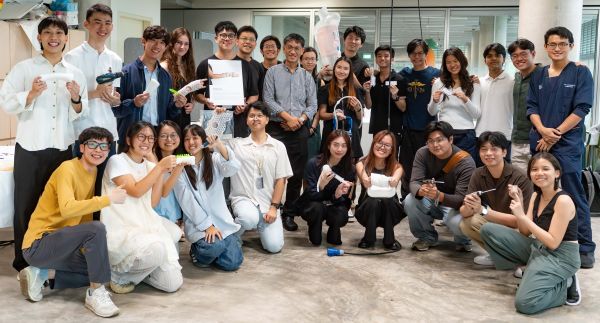
- Design for Medicine module: The Design for Medicine module was launched by our HealthX advisor and team in collaboration with the NUS Division of Industrial Design (DID) and the Centre for Healthcare Simulation (CHS). The programme provided a structured platform for medical and design students to work under clinician mentorship to co-develop medical hardware prototypes addressing real-world clinical challenges. Several prototypes were successfully produced and later showcased to the CEO of National University Hospital, as well as the dean and vice-dean (education) of NUS Yong Loo Lin School of Medicine, receiving strong encouragement for further development.
- International Medical Innovation Hackathon with King’s College London: In collaboration with King’s College London (KCL), the King’s College Entrepreneurship Society and the MedTech Society, HealthX co-organised a transcontinental hackathon featuring leading medical technology (medtech) ideas from Singapore and the UK. The event spotlighted differences in healthcare systems, surfaced diverse needs and examined how each system approaches innovation. The collaboration reinforced the importance of global perspectives in addressing complex healthcare challenges.
-
Workshops and learning platforms: HealthX has also hosted a series of workshops designed to lower the entry barrier to healthcare innovation. Covering both emerging and practical themes, these sessions have explored artificial intelligence in healthcare, panel discussions with medtech entrepreneurs, technology showcases at tertiary hospitals, design thinking for medicine, medical 3D printing and regenerative medicine. Together, they provided accessible entry points for students to gain exposure, learn from experts and build connections across disciplines.
Lessons from the journey
Reflecting on our progress, several lessons from the year stand out.
Innovation is accessible. It is not confined to seniority or titles. Anyone – whether a student on the wards or a seasoned clinician – can identify pain points, inefficiencies and gaps in clinical processes. The act of noticing and questioning “why” is often the first spark of meaningful innovation.
Multidisciplinary collaboration is essential. No single discipline can solve healthcare’s challenges alone. Effective innovation requires perspectives from medicine, design, engineering, computing and beyond. Collaboration across these fields is not optional; it is a skill that must be intentionally cultivated to transform ideas into viable, real-world solutions.
Doctors as translators. Clinicians have a unique responsibility in the innovation process: to frame healthcare needs in a way that technical experts can act upon, and to guide co-creation so that solutions remain clinically relevant. Their role ensures that new ideas are not only functional but also compatible with real-world workflows and regulatory requirements.
Innovation is not always disruptive. While breakthrough technologies often capture attention, incremental improvements can be just as impactful. Small but well-executed changes – streamlining existing pathways, improving scalability, or making care more accessible – can meaningfully improve patient outcomes and healthcare delivery.
Looking ahead
These lessons shape our path forward. The vision for HealthX remains clear: to nurture a sustainable ecosystem of student-led healthcare innovation and become a launchpad for future talent and ideas. We look ahead to expanding our collaborations, deepening our impact, and empowering the next generation of clinician-innovators.
As its founder and chairman, it has been a privilege to witness HealthX grow from an idea into a community that champions innovation and empowers students to create solutions that advance healthcare.
Moving ahead, healthcare challenges will only grow in complexity. But I believe that by learning and building together, we can create solutions that outlast today’s problems.
A word of thanks
Our progress this year was only possible with the support of many. We extend our heartfelt thanks to our advisor, A/Prof Dinesh Kumar Srinivasan, whose guidance and support played an important role in the founding and growth of HealthX.
We also extend our thanks to our partners and collaborators, including Prof Prashanth Jha (KCL), Prof Yen Ching Chiuan (DID), Dr Gene Chan, Dr Alexander Ng, Dr Cheryl Woo (CHS), and many others who have contributed to our journey.
Finally, to the existing and incoming HealthX Executive Committee – Harpreet Singh, Nicholas Lee, Nadia Yap, Jarrett Tan, Zhou Xinyan, Joel Tang, Darren Ho, Pranav Rao, Guang Shian, Marcus Lee, Kong Kei-Lyn, Jayden See and Avishi Gupta. Thank you for your belief in our shared mission and for journeying alongside me to build what HealthX stands for today.
HealthX Design for Medicine Workshop
