During a recent hospital retreat, the Singapore Health Services (SingHealth) Duke-NUS Medical Humanities Institute (SDMHI) facilitated a creative session using an approach that blended open-ended reflection, arts-based narratives and structured idea generation to invite deeply embodied engagement. We began by posing a metaphorical question: “If your hospital were a body, what part would you be?”
The participants paused, hands hovering over preserved foliage and found materials, tools curated to spark organic creativity. They had been invited to work with a curated selection of natural and found materials, including foliage, moss and organic objects in varying states of preservation – some freshly moist to the touch, others dried or preserved – chosen to engage the senses and support metaphor-based reflection.
What began as silence soon turned into excited chatter as participants began shaping “organs” with repeating, branching forms, stepping away from the familiar cadence of ward rounds, administrative work and budget reviews into a space where metaphor became a language for meaning making in clinical care. Participants were not instructed to represent specific ideas or metaphors; instead, they worked intuitively with the materials and reflected on what emerged through the making process.
We witnessed hearts weighted with patient narratives. We saw lungs designed to hold the collective breath of teams operating under chronic pressure. One clinician reflected, “Our team is the immune system: repairing damage before anyone realises something is wrong.” Another held up a pair of sculpted hands: “These heal even when cure is no longer possible. They hold families together till the end.”
One participant shaped a form initially read by others as a heart but described it instead as a womb: a first home characterised by warmth, protection and strength. In the participant’s reflection, this inner space came to represent what they hoped healthcare ought to provide: the place where care begins. It was at this point that many participants began to realise this was far more than a simple arts and crafts exercise. By visualising the organisation as a living body, they surfaced forms of tacit knowledge that may not have emerged through dashboards or engagement surveys.
By slowing the pace of discussion and engaging participants through material and embodied processes, creative facilitation allowed lived clinical experience to come into view. These insights shaped by sensation, memory and practice are not always readily accessible through verbal reasoning alone, and can support clearer identification of shared priorities and tensions, enabling more aligned and thoughtful decision-making.1
Importantly, the use of material, metaphor and making also altered the usual dynamics of group discussion. When participants worked with their hands rather than speaking from their titles, verbal dominance was softened and professional hierarchies receded into the background. Metaphor created a shared language that did not privilege any single discipline or rank, allowing junior and senior clinicians alike to contribute meaningfully. In this way, creative facilitation offered a practical method for amplifying voices that might otherwise remain unheard in conventional meetings.
What is creative facilitation?
Creative facilitation, as practised within established medical humanities programmes, is not an aesthetic add-on or an icebreaker at meetings. It is a structured pedagogy for guiding groups to surface reflection, emotion and collective meaning in participants from diverse professional and social backgrounds. Creative facilitation is especially suited where the stakeholders may hold different values and world views, where the system in which they are embedded is complex and where problems being tackled require adaptive solutions. Its value lies not in “being engaged” or “being entertained” but in creating the conditions for clinicians to stay with uncertainty long enough to respond wisely rather than reactively. Such facilitation integrates experiential considerations with cognitive objectives in the design of teaching sessions and meetings. From an educational perspective, there is the benefit of engaging the audience not only intellectually but also emotionally, facilitating resonance with what is being communicated. Creative facilitation is therefore oriented towards outcomes beyond informational exchange, including insight, culture change and innovation.
The versatility of creative facilitation enables teams to mix and match facilitation techniques based on setting and topics. Facilitation techniques at SDMHI span poetic medicine, visual thinking strategies based on art from the National Gallery Singapore, forum theatre, mindfulness training for flourishing in medicine, narrative medicine as well as sessions facilitated by our creative therapists from art and music therapy. Facilitation has also been used in undergraduate and postgraduate education, clinical meetings and leadership retreats. The range of medical topics covered include physical examination skills, communication techniques, empathy, patient safety, wellbeing of healthcare professionals, coping with death and dying, and interprofessional training. Creative methods transform conventional facilitation based on discussion and verbal output into an experiential activity that additionally utilises visual and embodied methods.
Refill to Regift
In a separate creative facilitation workshop focused on nurturing healthcare worker wellbeing, a participant shaped a small clay pinch pot titled Refill to Regift. The piece captured a familiar truth: when practitioners are required to pour endlessly from an empty cup, it eventually requires refilling. The creative facilitation prompted interoceptive awareness – the sensing of the body’s internal state. While clinicians are rigorously trained to observe patients, far less attention is given to recognising signals from one’s own nervous system. Interoception plays a critical role in emotional regulation, decision-making and resilience.2 Relational care depends on practitioners who can recognise when they themselves are running thin, not just those who are technically proficient.3
Creative facilitation offers a practical way of cultivating these capacities within healthcare teams by helping clinicians reconnect with tacit knowledge, bodily awareness and shared purpose. When thoughtfully integrated into meetings, teaching sessions and retreats, such approaches support collective sense-making and enable teams to engage complexity without prematurely narrowing it.
So, if your clinic or department were a body, which part would you be?
All artworks and reflections are shared with participants’ consent. Identifying details have been included or withheld where appropriate and reflections have been paraphrased to preserve confidentiality.
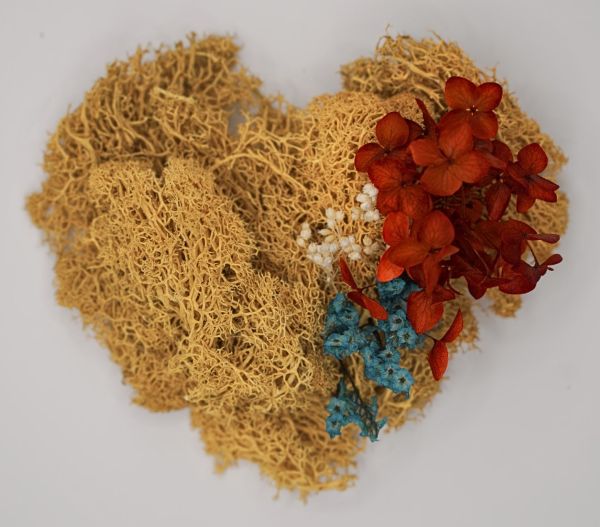
The Womb, Clinician Participant
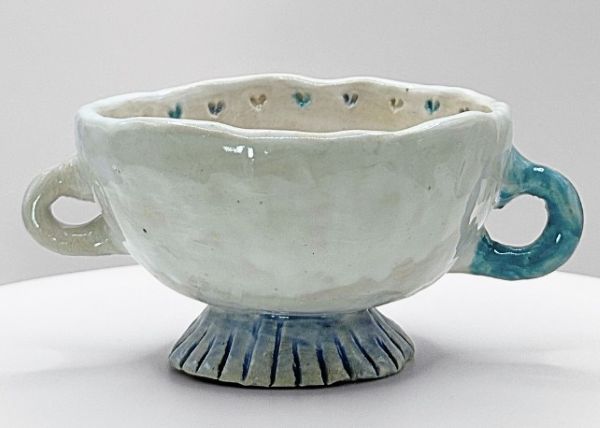
Refill to Regift, Clinician Participant
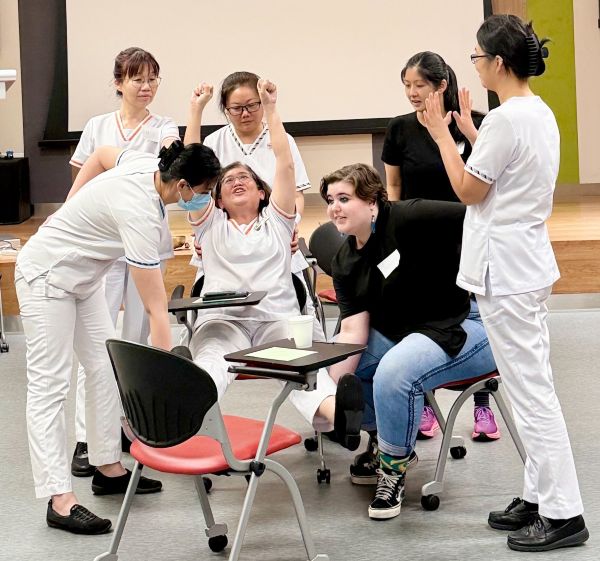
Non-verbal communication training in the “Gestures of Care” project at the National Heart Centre
