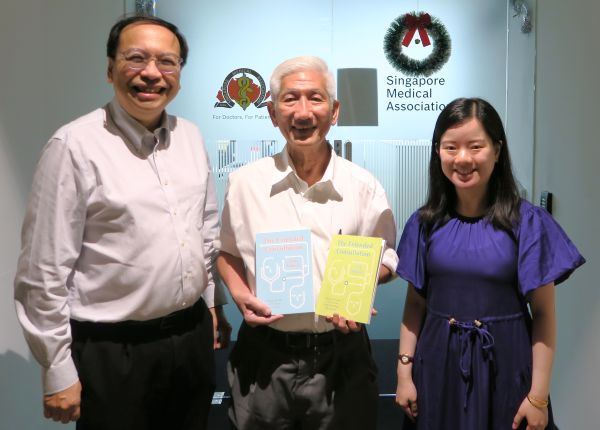
A/Prof Goh Lee Gan is a family physician and a well-known figure in Singapore’s medical landscape. Often nicknamed the “midwife of family medicine” for his role in pioneering family medicine training in the 1980s, A/Prof Goh has guided many batches of medical students to becoming full-fledged doctors. With the recognition of family medicine as a specialty in November 2025, A/Prof Daniel Fung (DF) and Dr Chie Zhi Ying (CZY) speak with A/Prof Goh Lee Gan (GLG) about his experiences in establishing and elevating the discipline of family medicine over the past decades, as well as about his good friend, the late A/Prof Cheong Pak Yean.
Journey into medicine
DF: Thank you for meeting with us, A/Prof Goh. Could you tell us about your journey into medicine, and how you became so passionate about family medicine?
GLG: I was in the science stream in Anglo-Chinese School’s Pre-University Science Class B. At the time, there were two choices of study for us: engineering or medicine. I chose medicine because I thought it would be easier to study.
DF: Medicine is easier than engineering?
GLG: I was really scared of mathematics! [laughs] Hence, I applied for medicine, went for the interview and received a letter saying I had been accepted. I told my mother, “Mum, I got a place in medicine.” And the rest, as they say, is history. The medical course at the University of Singapore was normally six years long, but those of us with good grades could skip the first year and enter as “super fresh”. Of course, that meant the seniors ragged us more severely: “You think you’re very smart, is it? Super fresh?”
DF: Did you stay in a hostel?
GLG: No, I was not a “hostelite”. I completed my five years of study, graduated in 1971 and joined Government service from 1971 to 1976. I thought it would be good to stay there for a while.
Serving the nation and postgraduate years
DF: What about National Service at that time?
GLG: Compulsory enlistment applied to those born from 1948 onwards. I was born in 1946, so I was exempt from the usual National Service for males, but I had to join under what was called a Specific Term of Engagement. This was deferred until I had completed my medical studies. The basic medical training lasted three months and we were posted to the army camps for two and a half years. I was posted to an artillery battalion as a battalion medical officer.
CZY: Did you have a bond to serve after graduation?
GLG: I had taken a bursary of about $800 a year for my medical studies and there was a bond for five years.
DF: Tell us about your housemanship.
GLG: My first housemanship posting lasted six months in KK Women’s and Children’s Hospital (KKH). After my KKH posting, I went to Thomson Road General Hospital, the predecessor of Toa Payoh Hospital, which later closed in 1997. Then, for my postgraduate training, I chose internal medicine because it was such a broad specialty. I wanted to know something about everything. Internal medicine covers the body systems in adult medicine, whereas other specialties concentrate on particular organs. I wanted that breadth, and I was happy with my choice.
DF: Did you take the Membership of the Royal College of Physicians (MRCP) besides the local Master of Medicine (Internal Medicine)?
GLG: I took and passed the local Master of Medicine (Internal Medicine) examination. I attempted the MRCP but did not succeed.
DF: Then you moved into general practice.
GLG: I joined Shenton Medical Group around 1976 and stayed with the group until 1987. It was a good arrangement. My background in internal medicine helped me manage the more difficult cases. Then in 1987, I was approached to join the University of Singapore, the forerunner of the present-day NUS, to teach family medicine as an undergraduate medical discipline.
Developing family medicine in Singapore
DF: Was that when the Community, Occupational and Family Medicine (COFM) Department was formed?
GLG: Yes. The Department was previously called Social Medicine and Public Health, but was renamed COFM to include family medicine. I was the first person to lead family medicine there.
DF: Where does family medicine sit in the University today?
CZY: COFM no longer exists as a combined department.
GLG: Family medicine has its own department today in the NUS Yong Loo Lin School of Medicine (NUS Medicine), led by Prof Jose Maria Valderas. There is also a Department of Family Medicine in Duke-NUS Medical School as well as the Lee Kong Chian School of Medicine.
CZY: How did you begin building family medicine?
GLG: It was Prof Chee Yam Cheng who asked me to kickstart family medicine as a discipline. We developed a collaboration among the three institutions of the Ministry of Health (MOH), NUS Medicine and the College of Family Physicians Singapore, which I think was a very good arrangement. My first task was to design a curriculum. Drawing on my experience with internal medicine, I organised the syllabus into eight modules, each lasting eight weeks. Half of them focus on population groups, such as adults and children, while the other half focuses on organ systems, such as cardiovascular, respiratory and gastrointestinal medicine.
CZY: Was this the basis for the Graduate Diploma in Family Medicine (GDFM) modules? I remember thinking they were very well structured.
GLG: Yes, it was the same framework that laid the foundation for the Graduate Family Medicine Programme.
DF: Which graduate qualification came first: the Master of Medicine in Family Medicine (MMed [FM]) or the GDFM?
GLG: MMed (FM) came first, and it was awarded by the Division of Graduate Medical Studies, NUS starting in 1993. That was our first step in postgraduate family medicine accreditation. We later launched the GDFM in 2000.
DF: As of November 2025, family medicine has become recognised as a specialty. How do the Academy of Medicine, Singapore (AMS) and the College fit into that picture?
CZY: AMS formed the Chapter of Family Medicine Physicians in 2014 and has a register of family medicine specialists.
GLG: It is a tripartite arrangement. MOH is involved in residency training; the University awards the MMed (FM) and GDFM; and the College provides training for the Fellowship of the College of Family Physicians Singapore (FCFP[S]) as well as the Family Practice Skills Course, which is the College’s family medicine continuing education programme.
CZY: To clarify, the University awards the GDFM and MMed (FM), while the College runs the FCFP(S).
GLG: Yes.
DF: How do you encourage doctors to keep learning without making every stage another examination?
GLG: Continuing medical education (CME) offers one way to do that. You continue learning through CME rather than repeatedly sitting examinations. As long as you practise, you need that continuing component.
DF: In disciplinary tribunals, we often focus on sanctions for ethical or clinical failings. But what happens afterwards? How do we help a doctor learn and practise safely again? Could the Colleges provide that kind of rehabilitation?
GLG: You are right, Daniel. There should be two parts: punishment and repair. Rehabilitation is the repair. Someone who has made a mistake may face a penalty, but there should also be a way to help that person improve.
DF: At present, we can sometimes recommend a course, but we could also develop training that responds to particular gaps in practice. It could help doctors who have faced disciplinary action and others who recognise that they need to strengthen their skills.
GLG: That is worth thinking about. Once a doctor has paid for a mistake, can we help prevent it from happening again? The response should depend on the seriousness of the case. But where rehabilitation is appropriate, we should ask what would actually help the doctor change.
DF: Such courses could benefit many of us. In psychiatry, for example, we regularly ask how to help doctors practise better and avoid foreseeable risks.
GLG: CME can help doctors practise better and avoid mistakes.
A legendary duo
DF: Let us talk about the late A/Prof Cheong Pak Yean, with whom you have been called a legendary duo. Both of you co-wrote a book titled The Extended Consultation.
GLG: Cheong Pak Yean developed the idea of the extended consultation. He saw that some acute problems could be addressed fairly directly, but also that other patients had deeper difficulties: problems in their relationships, family life or daily living. A consultation had to make room to recognise those problems. That thinking led us to write The Extended Consultation together, the first edition of which came out in 2017 and a second edition in 2024. It describes several approaches to helping patients with problems of living: pattern, problem, presence and positive.
DF: Family doctors often have limited time, whether in a polyclinic or private practice. How can they make room for an extended consultation?
GLG: Rather than ask every doctor to spend a great deal more time on each patient, The Extended Consultation offers a framework for thinking. First, you recognise that a patient may be struggling with a problem of living. Then you consider how to help. With the pattern approach, for example, you may notice that the patient responds in the same way whenever he/she feels unable to cope. You can ask about that pattern and explore what is going through his/her mind. This framework gives the doctor a set of strategies that are still useful even when consultation time is limited.
DF: Does “extended” mean that the appointment itself must be longer?
GLG: Not necessarily much longer. In the course we run, we use scenarios to show how a doctor can apply the approaches in a short consultation.
DF: How long is a typical consultation these days? About ten minutes?
CZY: It may be ten, or perhaps 15 to 20 minutes long for a more complex family medicine consultation.
DF: Then perhaps what is extended is the doctor’s way of thinking: taking into consideration social circumstances and other factors affecting health. Continuity also gives a family doctor more than one opportunity to help. When I read the book, I wondered about support beyond the GP’s room too. Could other people and services help carry that work forward?
GLG: The doctor can begin within an ordinary consultation by recognising the problem and choosing an approach. Positive psychology, for instance, may help someone who lacks confidence. We teach these approaches in a course that Cheong Pak Yean cared deeply about.
DF: Who continues to teach the course now that A/Prof Cheong is gone?
GLG: Several of us, including Asst Prof Ong Chooi Peng and me, with other colleagues. The course is offered under the College’s Family Practice Skills Course as CME.
DF: It sounds as though doctors learn counselling skills and ideas from positive psychology. That seems very useful.
GLG: We should invite you to speak the next time we run it.
DF: Welcome to do that.
GLG: We also have a postgraduate course called CCC: Communication, Consultation and Counselling. The opportunity is there; the question is how widely doctors take it up.
CZY: It is compulsory in the GDFM. MMed (FM) trainees also learn these skills, though they are embedded in the programme.
GLG: In the undergraduate medical curriculum, we have a Communication with Patients course for second-year undergraduates, which I used to teach many years ago.
CZY: That teaching is now part of the clinical skills foundation.
GLG: The postgraduate CCC course grew out of that work too.
Personal life and closing reflections
DF: Tell us a little about your family.
GLG: We have one son, who is now a plastic and reconstructive surgeon. He is married and has three children.
DF: What else occupies your time these days? What are your hobbies?
GLG: I serve as a medical director at nursing homes with Methodist Welfare Services, which has a hospice and long-term care services at Bukit Batok and Woodlands. I visit once a week to see patients whom the resident physicians would like me to review. A doctor might ask me to review a persistent rash, for example. In an older patient, we would consider possibilities such as fungal infection or eczema. That is the sort of clinical work I still do.
About hobbies, I like gardening and keeping Japanese koi. Unfortunately, because my residence is near the sea, the sea otters would come and make away with some of the koi once in a while. Thankfully, the last assault was three years ago, and I lost three out of my ten koi in that attack.
DF & CZY: Thank you for your time, A/Prof Goh!
GLG: Thank you both too, and the News team as well.
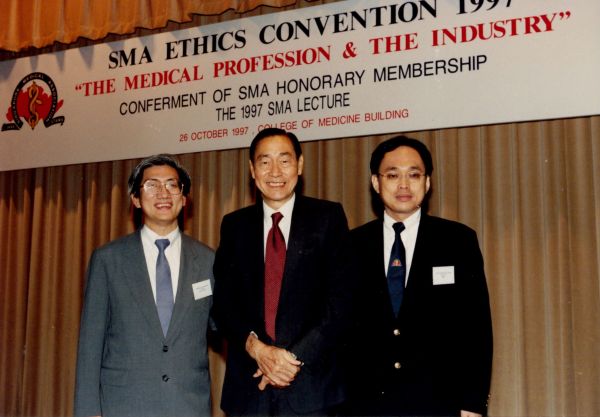
A/Prof Goh Lee Gan (left) with A/Prof Cheong Pak Yean (right) and Dr Wong Heck Sing (centre) at the 1997 SMA Lecture
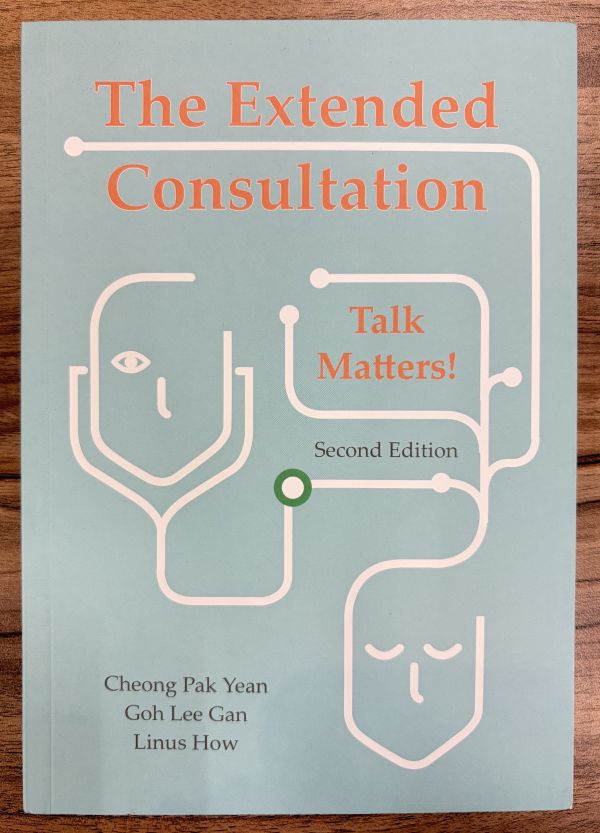
The Extended Consultation (second edition), written by A/Prof Goh and the late A/Prof Cheong Pak Yean
