SMA participated in the 40th General Assembly and 61st Council Meeting of the Confederation of Medical Associations in Asia and Oceania (CMAAO), held from 2 to 4 September 2026 in Seoul, South Korea. SMA was represented by Dr Chong Yeh Woei, CMAAO Chairman, and Clinical Asst Prof Benny Loo Kai Guo, CMAAO Councillor and SMA Council member.
Hosted by the Korean Medical Association (KMA), the meeting brought together delegates from Hong Kong, Indonesia, Japan, Malaysia, Myanmar, Nepal, the Philippines, Singapore, South Korea, Taiwan and Thailand. Beyond the formal programme, the gathering was a welcome opportunity to reconnect with colleagues from across the region and build on friendships developed through previous exchanges.
For the SMA delegation, this included a reunion with colleagues from the Malaysian Medical Association and the Hong Kong Medical Association who had visited Singapore last year, as well as a chance to catch up with a former Indonesian colleague from the Junior Doctors Network. These personal connections are an important part of such international meetings, helping national medical associations maintain open channels for collaboration and the sharing of ideas.
Learning from different health systems
The country report session offered a broad view of the work being undertaken by medical associations across Asia and Oceania. Delegates shared updates on initiatives to engage their members, the wider medical profession, the public and their respective health services.
The presentations also highlighted the diversity of health systems and governance structures across the region. Each country faces its own combination of workforce pressures, healthcare financing issues, regulatory responsibilities, changing public expectations and the need to maintain trust in the profession. While the specific circumstances differ, many associations are working through similar questions about how best to represent doctors, contribute to health policy and support improvements in patient care.
Importantly, the reports were candid about challenges and work still in progress. This allowed delegates to learn from successful programmes and also the different approaches being tested and refined across the region. Clinical Asst Prof Loo presented Singapore’s country report on behalf of SMA, giving a concise overview of SMA’s work in professional advocacy, member engagement, support for junior doctors, medical ethics education and academic development.
What does professional autonomy mean today?
The main theme of the meeting was “Professional Autonomy in Medicine”. The 23rd Taro Takemi Memorial Oration included presentations by Dr Otmar Kloiber, former Secretary-General of the World Medical Association (WMA), and Dr Ahn Ducksun, Professor Emeritus at Korea University Medical College and Director of the KMA’s Research Institute for Healthcare Policy.
Dr Kloiber discussed the WMA’s definition of professional autonomy and clinical independence, described as the processes that allow individual physicians to exercise their professional judgement in caring for patients without undue or inappropriate influence from external parties. At the same time, such autonomy remains bounded by professional standards, the available evidence and the realities of healthcare systems and resources.1
Dr Ahn shared about the historical background of the KMA and discussed its role as both a statutory professional body and a trade association representing doctors. His presentation explored the challenge of balancing responsibilities to the public and the profession, including the KMA’s roles in professional standards, self-regulation and the collective representation of doctors.2
During the symposium, Clinical Asst Prof Loo presented Singapore as a case study of professional autonomy within an accountable healthcare system. He emphasised that autonomy does not mean unrestricted freedom for doctors. Rather, it is the ability and responsibility to exercise sound clinical judgement, advocate for patients and explain decisions within appropriate ethical, legal, organisational and resource boundaries.
The discussions show that professional autonomy is shaped differently in each country, depending on their respective healthcare systems, regulatory framework, financing arrangements and relationships between the profession and the state. Nevertheless, doctors from the various nations share a common interest in preserving appropriate clinical judgement while maintaining accountability, patient partnership and public trust.
Moving forward
A key moment during the General Assembly was the handover of the CMAAO presidency from Dr Anil Bikram Karki of Nepal to Dr Kim Taeg Woo of South Korea, who is now the 43rd President of CMAAO.
The meeting was also attended by senior WMA leaders. Dr Jacqueline Kitulu, WMA President, delivered a congratulatory message, while Dr Ramin Parsa-Parsi, WMA Secretary-General, presented the WMA Strategic Plan 2026-2030.
This meeting in Seoul was a useful reminder that despite the differences between national health systems, medical associations across the region share many of the same concerns. Just as importantly, it provided the opportunity to renew friendships, establish new connections and continue learning from one another.
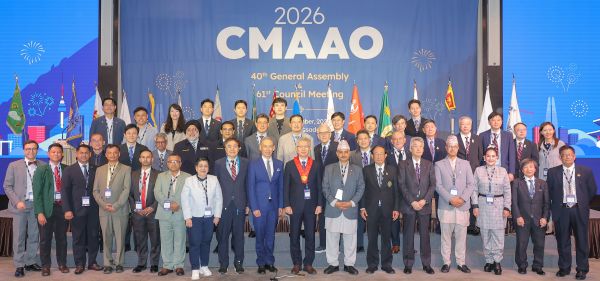
CMAAO 2026 delegates
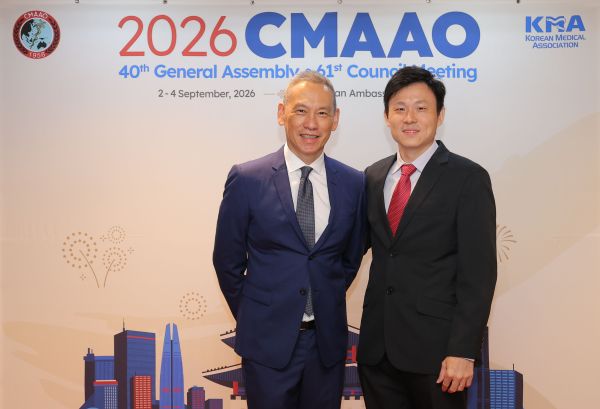
Clin Asst Prof Benny Loo with Dr Chong Yeh Woei as SMA representatives to CMAAO
