Over the course of SMA News' 60 years, many Editors have helmed the newsletter and brought with them their unique dynamism and vision. To celebrate and pay tribute to their efforts and dedication, Dr Chie Zhi Ying (CZY) and Dr Lim Ing Haan (LIH) speak with past and present Editors Prof Wong Tien Yin (WTY), Dr Toh Han Chong (THC), Dr Tan Yia Swam (TYS) and Dr Tina Tan (TT) about their tenures leading the newsletter.
Note: Prof Wong Tien Yin was unable to attend the interview in-person and has contributed to the interview via email.
LIH: How did each of you come to be the SMA News Editor? Perhaps we can go in chronological order.
WTY: I was Editor from 2003 to 2004. As a proud Singapore-trained doctor, I always wanted to contribute in a meaningful way to the profession. I was interested in new ideas and reaching out to the younger members of our professional doctor community. SMA News was a wonderful platform to reach out, engage and connect. This was way before the era of social media, Facebook and Linkedln.
THC: I was Editor for ten years from 2004 to 2014. I remember that evening when Tien Yin took me out for dinner and said, “Can you take over my job?” I believe it was because he was taking up a position at the University of Melbourne and was going to become very busy overseas. But honestly, like all of you, I have been sort of involved in drama, debating, writing and editorial work much of my life. I was the editor of my school magazine, my senior high school magazine and my university society magazine; it is something that comes naturally to me.
TYS: Did you write for SMA News before becoming Editor?
THC: I do not remember. I think I did, but very rarely.
TYS: I went to check, and my first article written for SMA News was a parody of The Devil Wears Prada.
THC: Really? No way!
TYS: It was titled “The Devil Wears Scrubs” and it was published in the October 2007 issue under a different name at the time: Tan Yixuan, not Tan Yia Swam. And the next thing I knew, someone called Prof Toh Han Chong, Senior Consultant, National Cancer Centre Singapore, somehow asked me to meet for lunch.
THC: Also known as “old person”. [laughs]
TYS: I was only a third-year general surgery medical officer at the time. I thought, 莫名其妙 (“how odd”), I had submitted my article already and he still wanted to meet me? We met and talked about a lot of things, and he invited me to join the Editorial Board. I continued writing on and off for the newsletter, then eventually became Deputy Editor in 2008, and Editor in 2014.
THC: I passed the baton to Yia Swam, since I had served as Editor for ten years.
TT: Ten years feels very long.
THC: Too long.
LIH: How long were you there for, Yia Swam?
TYS: I served as Editor for six years from 2014 to 2020 and stepped down because I became SMA President.
TT: My story of how I came to be on the Editorial Board is that one day, when I was still a medical officer, I came home post-call. All of a sudden, my phone rang; it was a person I had not talked to in a few years because her name was associated with surgery days for me, which were a little scary. [laughs]
TYS: Who could it be?
TT: The first question DrTan Yia Swam asked me was, “Are you a Member of SMA?” I said, “Yes...?” And the next statement was, “Your classmate, Chia Ghim Song, arrowed you because you did some yearbook stuff in medical school.” So that is how I came to be part of the Editorial Board – because I got arrowed by my classmate.
As for how I became Editor, it is a similar story. She met me one day at the start of the COVID-19 pandemic and took me out for lunch. No, there was actually something else before that. She came to my baby's 满月 (first month celebration). While holding my baby, she said, “You're the next one hor.”
THC: Wah! Very direct.
TT: Yeah, she was holding my baby, you know!
TYS: The succession planning is very important. [laughs] Because you had completed your family, right? With your family settled, you were ready to take on more responsibility, so you could be the next one. The checklist was all ticked.
TT: Then, similar to this, the meal came and she told me again, “Okay, you're up next.” It has been six years since, and I am still the Editor.
Different experiences, similar goals
THC: But you have always been a good writer. You have written and published some children's books, right?
TT: I would not say I am a good writer, but like you, I have always been interested in the written word. I am part of the pioneer batch of Duke-NUS Medical School, and I did indeed help plan and coordinate the first yearbook, which is what I think Ghim Song remembered.
LIH: Tina is a graduate of Duke-NUS and Yia Swam is from NUS Medicine, right? And Han Chong studied in the UK.
TYS: I think that influenced the kind of people interviewed in the newsletter. I remember that under Han Chong's leadership, the newsletter invited a lot of amazing national experts. I remember feeling that these people were so powerful and amazing, yet I did not know who they were. It was right that we should celebrate our own local people.
THC: I have never heard that sentiment until now and I think it is great that you have that feeling. I had been away overseas for so many years, and I believed that it was important as well to showcase our local experts, icons and legends, as part of Singapore's medical history and legacy.
TYS: Interesting. Our experiences influenced the way we directly ran the newsletter. I reread my key Editorials to recall what my thoughts at the time were. In my first column as Editor, I said that the newsletter should never become a voice for any one group or party. It was my stance that SMA News should be by doctors, for doctors.
Shaping SMA News through the eras
LIH: This leads well into the next question. What were your visions for the newsletter?
WTY: I sought to promote the identity of Singapore's medical profession, particularly to the young. During my tenure, I wanted to focus on our young doctors' lives, their training, their challenges at work and their career progression. At that time, Singapore's medical community was dominated by many senior members of the medical profession, but few of the younger doctors were engaged. I feel SMA News played this key role well.
THC: For context, we should remember that we were all Editors at different historical moments in life. I came in as Editor only after the SARS outbreak, which was a very dark and challenging period. There were some seminal articles that came out during that time. One of them was the classic 13-part SARS Chronicles by Prof Chee Yam Cheng, published across Tien Yin's era. Prof Chee has an elephant's memory and a giant intellect, and his series provided a strong narrative of what was happening on the ground in Tan Tock Seng Hospital while everyone was so cut-off. Those were the early days of the Internet and news was less readily accessible – there was neither WhatsApp nor social media and most of us did not know what was going on.
This was the period in which I became Editor. And, as Yia Swam says, I come from a very liberal kantang world, having studied medicine in the United Kingdom. I believe that the written word is very powerful – the news and media are very powerful voices of influence – and so I saw the newsletter's role as being very important, both as a mouthpiece for what SMA believes in and what the Association wants to represent for doctors. That was the kind of vision I had, to highlight who doctors are, what doctors do and the fruits of their many good works. And that is where the interviews come in. After all, we have so many different kinds of doctors across so many fields, including outside the practice of medicine, and we should be proud of them.
TYS: For me, I had a strong focus on the operational aspect of the newsletter. I sat down with the News team and discussed with them the challenges they faced in the day-to-day running of SMA News. One of the problems they often faced was with late submissions, so I enforced a regime of forward planning, for the Editorial Board to roughly plan out the entire year in advance.
TT: Oh, it is working very well.
TYS: I also wanted to lessen work for myself, so I made sure that most issues would have a co-Editor. Every time they reached out to me to write the Editorial, I said, “Call these other people lah!”
TT: I do not know how Han Chong managed to write a full column every single month. Some months, I struggle to write even 150 words! [laughs]
THC: I wrote often, but I do not think I wrote every single month!
TYS: I started that practice formally. I looked into what the Editor's role should be, which includes directing and shaping the flow of the newsletter. I was inspired by The Devil Wears Prada, right? So, I went to read about Vogue and other fashion magazines. The monthly Editorial was born from that, as well as having an attractive front cover and stricter forward planning for our issues.
TT: Wait, you mean SMA News did not always have an Editorial?
THC: There were some issues where we just did not have Editorials.
TT: So, it was not a consistent practice to introduce the issue in the Editorial the way we do now.
THC: Occasionally, I did so. But my column was often commentary on all sorts of things, not necessarily on the issue focus. However, the SMA President's column was very consistent.
TYS: The consistency of it contributed somewhat to our challenges with the newsletter's timeline. That is why I was quite strict in enforcing our planning – like a surgeon, you must plan your timeline carefully.
TT: It has worked really well, and it helps the team greatly. At our last meeting, we planned all the way to the end of the year. I was so happy. As for me, my vision is to not rock the boat. [laughs] Shortly after I took over, there were staffing issues that caused disruptions, particularly amid the COVID-19 pandemic.
Noteworthy moments
CZY: What are some of the challenges and/or milestones of your tenures as Editors?
WTY: For milestones, I am proud that we had a good younger team of Editorial Board members, and we reached out actively to have more interesting articles, including interviews and solicited articles from broader members of the community. We also highlighted many of the problems faced by house officers and medical officers in those early years. As for problems, a big one we encountered was that we were all very busy and it was hard to have meetings and discussions. Many of the younger people especially were not able to contribute. We also had issues with some contributors who wrote on more controversial areas, which had to be managed closely.
THC: One interesting thing that happened in my time was that the Internet was beginning to take off, in the late 1990s. One of the most difficult things for any newspaper – not just us, even the global and local mainstream newspapers like The New York Times, The Straits Times – was the potential impact of the Internet on our readership. There was a lot of discussion about who would read physical newspapers with the increasing popularity of the Internet.
LIH: Even at such an early time?
THC: By 2004, people were already scrolling through Yahoo and such websites for their news! I had many discussions with our staff about how much online presence we needed to have, before kickstarting the newsletter's online presence. That was both a major challenge and milestone of my time as Editor, something that was at once exciting and uncertain and interesting. But somehow, doctors do like to smell their hardcopy, because they still put SMA News in their clinics and hospital waiting rooms. [laughs]
TYS: As Dr Wong Chiang Yin likes to say, we can read SMA News in the toilet!
TT: I would like to add on that at the last Editorial Board meeting, I had a conversation with the staff about the potential removal of print copies of SMA News, which I felt a little opposed to.
LIH: Do not take them away! Let people opt out; I want to keep my copies.
THC: Yeah, they are very sentimental.
TT: This topic arose because with the changing times, there is a significant percentage of our readership who do not necessarily want print copies, and there are costs associated with continuing to provide hardcopies. Young people also do not read print as much. No decision has been made yet on this, but it is a new challenge we are facing: how to stay modern and relevant for everyone.
On writing incognito
THC: There is another challenge I encountered during my tenure: handling anonymous and pseudonymous writers. SMA News has had many such writers over the years and many of them have contributed insightful and well-loved articles. But it was challenging to manage because when writers do not have their real names attached to their articles, it becomes easier for them to have less restraint and be bolder. There is often much wisdom in these articles; anonymity enables people to share their honest feedback on the conditions they see around them. But the protection of anonymity can also lead to very emotionally charged articles that can cause backlash. There are always two ways to say something, and if you say it in a very strong way, some people can become very sensitive. Then, as the Editor, the backlash comes to you.
TYS: I wrote a couple of anonymous articles before. At the time, I was a junior doctor complaining about training, and I wrote under the pseudonym of SK Warrior, as in saikang warrior.
THC: Yes, I remember that. As a junior doctor, you must have been concerned; you did not want to get tekan. [laughs]
TYS: Yes, of course. But after that period, I believed that complaining anonymously is one thing, but to make a systemic change, you need to put a name to your words. That shaped my later choices to push for more systemic changes. Even if it is controversial, if I put my name and face to it, my words are honest and sincere.
THC: I love The Economist, and their principle is to not publish any name for its authors. I knew its Asia-Pacific editor, but she would never write in her name; there is no byline in any article and there is no name. The effect is that they speak in unison as one voice, and the editor in chief would potentially take the hit if any one journalist writes something that evokes a negative response. Which is kind of sad, right?
I do think the option of anonymity is still important because anonymous writers often say things that other people want to say but do not dare to. Plenty of things need to be said, but when anonymity encourages excessive indiscretion, it creates challenges for the Editor to handle. Moderating overly strong, contentious content can in turn create some conflict with the author's vision, so it was a delicate balance to strike. There have been times where I had to reject submissions entirely, which sparked off its own problems.
LIH: I believe that most anonymous writers are standing up for the average doctor when they speak uncomfortable truths.
THC: It is true that they can sometimes represent the otherwise unspoken stance of the profession. But that cannot be taken for granted, and the onus is on the Editor to manage the situation with care.
TYS: It is good that we have the occasional anonymous writer, because people do want to be whistleblowers when there is the need. And if you find that the article is fair with some insight, some way to improve the system, then that is all the better; it will not just be bashing.
TT: Incidentally, I have just accepted a new anonymous writer, so our readers can look forward to that. But that challenge of managing submissions so that they are not too one-sided is something that crops up repeatedly, even with named authors.
Expanding the newsletter's scope
THC: What about your other challenges or milestones, Tina?
TT: The biggest challenge is meeting timelines! As for milestones, I have two that come to mind. During the COVID-19 pandemic, I was approached by Dr Joycelyn Soo when she was still a medical student. She expressed a very keen interest to be a part of SMA News even as a student. So I said, how about we start this role called “student correspondents”? And now we have local student correspondents and even one who is studying in the UK. Joycelyn connected us with Helen Cai, who is studying in the UK, and from there we started this column that I envisioned would be like Letter from America.
THC: Are you thinking of that radio broadcast series by Alistair Cooke? You are very literary! He belongs to your father's generation.
TT: I have the essay compilation of the series; and that is the story of why we have a bimonthly Letter from the UK. The other milestone I am proud of is an initiative started by Yia Swam. She had a couple of doctors who would contribute illustrations semi-regularly, and I wanted to do something similar. Now from those two contributors, we have a pool of seven illustrators. Now that I am familiar with their art style, I can tap on them to complement appropriate articles.
LIH: Apart from the forward planning you introduced, what other notable milestones did you have in your tenure, Yia Swam?
TYS: I would say: getting to know the entire team more, both Editorial Board members and staff; trying to showcase more local talents, especially having a good mix of colleagues from both the private and Government sectors, and those with unusual specialities. Our Editorial Board meetings also became a lot more interrogative. [laughs] I recall that our meetings during Han Chong's time were quite casual. You would talk, talk, talk, and the rest would say, “Can, can, can.” Then, you would ask, “Who will write this article? Can anybody write it?”, and there would be silence. I made sure that everybody was arrowed constantly. “We need this and this, I leave it to you, please find the appropriate writers,” and so it was clearer for how everybody could contribute. With a very clear direction on timeline and whom to chase, the News team could become more efficient. Another thing is that I got the team to upload on our website the digital copy of every issue dating back to the year 2000.
Looking ahead
CZY: What are your hopes and expectations for the future of SMA News?
TT: One of the nice things about being Editor is that sometimes, randomly, especially at the SMA Annual Dinner, there are people who come to me and say, “Hey, I read this article,” or “I read what you wrote.” And it continues to amaze me that people are actually reading our newsletter. I just hope that people will keep reading it and that we will be able to stay relevant and in a way that appeals to everybody. We were talking about different historical trends, right? Now we are at a point where we talk about whether we still need print copies. Artificial intelligence (AI) technology has also cropped up, and we had to spend some time this year coming up with guidelines for AI use in submissions. So, my hope is that we can navigate all these challenges.
TYS: Likewise, I was also always worried in my six years as Editor. You spend so much love and effort to curate and proofread the content, and yet you do not know whether anybody is reading them or not. But you are right; people remembered me when I became SMA President. Some called me “the SMA girl” because my name and face appeared so frequently in the newsletter with my monthly President's Forum column. Whether you are Editor or President, people do not really care. They just remember, “Oh, you're the SMA woman, you're the SMA girl.” But as for my hopes, I hope that SMA News will be relevant not just for doctors but will also influence the public as well, because it is a public domain newsletter. I hope that more journalists and members of the public will read through the struggles that doctors have, and learn about our loves and our concerns. Sometimes, I purposely take some of our articles and send them to my journalist friends.
THC: I think it is heartening that people are still reading our newsletter. In the modern day, people seem to be more aware of current affairs and social issues through social media, and often they will not stand for certain things; we can see that there is an evolution of how people think. But I think one important thing about doctors is that we came into the profession believing in something and having a conviction for our vocation. You all have very strong ideals and values, right? And I can see all of this coming out; that is why we and our contributors can be very vocal about the issues we care about. SMA News represents a group of people who are doing good things, not just in the medical sector, but also doctors contributing on a big stage like Dr Beh Swan Gin who was chairman of the Singapore Economic Development Board. That representation we have is also very important.
WTY: I hope that the newsletter continues to reach out to all groups of doctors – the senior members, the junior members, those who are trained overseas and are part of our community, those who are not in active clinical practice but in academia, industry, Government, etc. Doctors have many roles and we need to capture representation of them all.
Final reflections
LIH: I really need to thank Yia Swam. You are the one who brought me onto the Editorial Board.
TYS: Yeah, I remember. We were trying to revamp and get more ladies onto the Editorial Board about two years ago, and I was digging through the list of contacts I knew in the private sector.
TT: And I could not even meet you then because of the COVID-19 pandemic. I remember we only had a phone call. It was only much, much later that we met in person.
LIH: It was quite strange that I did not get to meet everyone face to face. [laughs]
TYS: Getting people into Association work can be an odd fit, you know? Some people have very strong ideas of what they want to do, and when they find that the Council is perhaps not as strong or vocal as they like, that we do not take as much of a stand as they prefer on particular issues, they tend to distance themselves from our work. Some people also do not want to commit the time – because it is very demanding on that front. So, after a while, you do have to form friendships to really enjoy being out here and not, for example, working or being at home by yourself. Some people quietly drift away after one or two years because of that.
THC: But remarkably, some people stay for a long time.
LIH: Like yourself?
THC: Like Dr Lee Pheng Soon.
TYS: And Dr Wong Chiang Yin, who has served on the Council for 31 years as of 2026.
LIH: Overall, I think SMA News has done a great job so far at highlighting most of the profession's concerns. Not just that, but we also talk about lots of fun things.
TYS: The travel articles have always been a highlight.
THC: That is true. In my time, Dr Martin Chio wrote a lot of travel articles.
TYS: Then Dr Oh Jen Jen as well.
TYS: We also highlight some of the medical mission trips to the ulu parts of the world.
THC: I think that is an important thing to highlight. Because it is common for doctors to undertake such charity work and go on humanitarian missions.
LIH: A lot of doctors do mission trips here and there. You can see it on their Instagram and Facebook pages.
TYS: Another thing I always loved about being the Editor is when random doctors from who knows where send an article out of the blue. I ask myself, “Who is this?” and after a Google search, find out that it is some lonely GP in solo practice somewhere. It is always quite touching that they suddenly feel this need to write. And they are always very shy about their submission. They will text, “Oh, I'm not sure that my article is good enough.” And I reply, “Can, good, we welcome all writers.” They say, “Oh, but I don't write very well,” and I say, “Eh, you're a doctor leh, what do you mean by that? Just write, just send it in. My team will double-check it for you.” They usually send us some bits of reflections or some cute little patient anecdotes.
THC: Medicine has a lot of these human-interest stories, and doctors see the human condition and humanity up close. That is why doctors make for great writers like John Keats, Arthur Conan Doyle, Anton Chekhov, Lu Xun, Somerset Maugham, Khaled Hosseini, Oliver Sacks and more.
CZY: Thank you all for your time and service, and may SMA News continue to flourish for many more years to come!
The past 60 years of our newsletter have been sustained by the dedication and continued efforts of our Editorial Board and contributors alike. If you are keen to play a part in shaping and contributing to the future of SMA News, write in to us at news@sma.org.sg today!
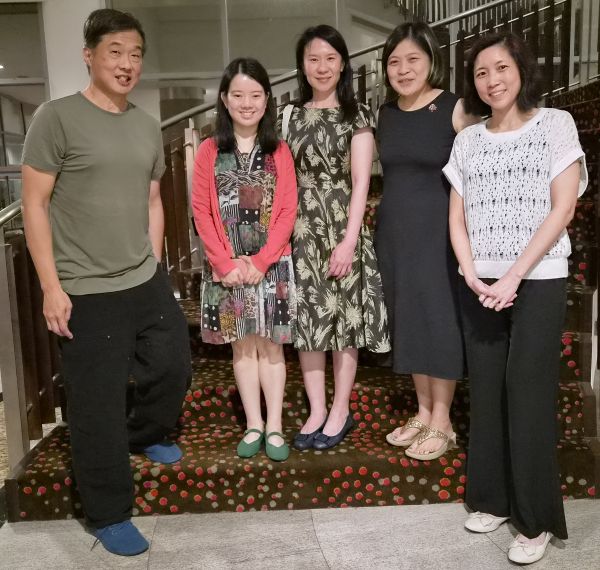
Past and present SMA News Editors and Editorial Board members gather for an evening of retrospection
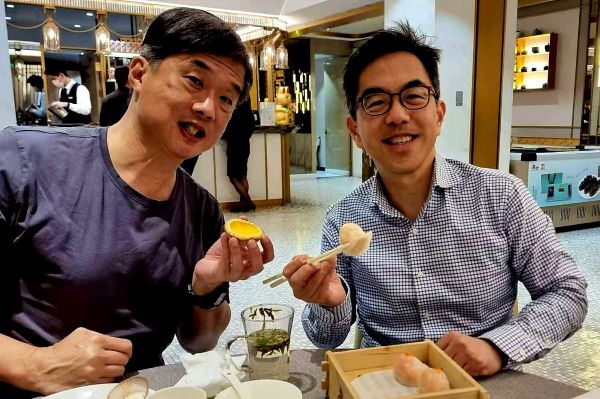
Dr Toh Han Chong (left) and Prof Wong Tien Yin (right) sharing dim sum
