Seasons change, but the age-old question of why one enters the medical field prevails. First published in the March/April 1996 issue of SMA News, this article by the legendary duo of Prof Goh Lee Gan and the late A/Prof Cheong Pak Yean reflects on three major dimensions that define the practice of medicine.
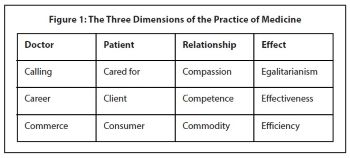
The practice of medicine can be viewed in several dimensions. First, medicine is a calling. The patient is a fellow human being to be cared for with compassion. This has since time immemorial been, and still should be the raison d'etre for the practice of medicine. Medicine is also a profession. As a career, the patient is a client deserving competent and effective care. Increasingly however, medicine is being looked upon as a commerce, with the patient being treated as a consumer. Healthcare then assumes the features of a commodity. These three dimensions of the practice of medicine can be tabulated as in Fig 1.
Medicine as commerce strikes a raw nerve in many doctors. It threatens their value systems. Yet the practice of medicine of today cannot be divorced entirely from commercial considerations. Some may deal with the untidy state of affairs by openly accepting it as reality, much to the ire of some colleagues. Such doctors are likely to be labelled as mercenaries. Others deal with it using the dictum of "Robin Hood" as subterfuge. Robbing the rich as a means to the end of expropriating resources for the "poor" is their way to rationalise medicine as commerce.
The "Robin Hood" dictum may have been acceptable in societies where economic inequalities abound, where the majority are poor and deprived of basic healthcare. In rapidly developing societies with a growing middle class however, medical "Sherwood Forests" have less reasons to exist. The burgeoning economic power of the large middle-class allows doctors to be equitably remunerated without resorting to banditry. In the context of these societies, there are positive aspects of commerce such as the efficient production of needed services and fee schedules based on resources expended to create these services. In this setting, administering to the poor and needy can still come from subvention of government and from the charity of doctors and society.
It is tempting under free market conditions to provide services that are wanted by those willing to pay. Unfortunately, their wants may not be congruent with their medical needs. Doctors must not relinquish their responsibilities as patients' advocates and healthcare managers. They should not use the situation to maximise their financial gains. To do so is to forsake the covenant of the medical profession to society to practise medicine for the benefit of the patient.
We are witnessing the surging demand for more and more sophisticated healthcare in the emerging economies of our Asia-Pacific Rim. Advances in medicine create more diagnostic and treatment possibilities and strain resources. To resolve the conflicts, the market place is increasingly relied upon to arbitrate the mix of efficient production of healthcare, the professional yardstick of effectiveness and/or egalitarian principles of medicine as calling. As healthcare delivery systems become more complex and capital intensive, non-doctor investors and managers enter the scene. It is easy to decry the excesses of the commerce of medicine and to hark back to simpler times when doctors can practise medicine as both a calling and a career without having to acknowledge the commercial dimension. Doctors now need to give the situation a new appraisal. If they stand aloof, it is likely that the command and control will move into the hands of these investors and managers.
Where do we stand? It is clear that we cannot ignore the practice of medicine as commerce. However, we need to keep this dimension in check. Medicine as career and commerce without a calling may be financially and intellectually rewarding to doctors but they will lose the covenant they have with society. Practising medicine as a calling and commerce but without the rigours of professionalism is also not the answer. It tends to create a levelling down effect when effectiveness is subjugated to efficiency and egalitarianism.
The challenge is to strike a balance of all three dimensions so as to attain an egalitarian, effective yet efficient healthcare system. However, we need to derive our raison d'etre from the practice of medicine as a calling. This is sine qua non for the existence of the profession.